

Leather Golf Gloves vs Synthetic: Which Should You Buy?
Every glove wall in Britain is a two-party system, and most golfers vote by accident.
The honest comparison: leather golf gloves (cabretta, if they're any good) win on feel, grip and breathability, and synthetic gloves win on lifespan, rain and price. Golfers who care how the club feels end up with cabretta for rounds that count and a cheap synthetic for the range and the rain. This guide covers both halves of that trade, including the one we lose.
What cabretta leather actually is
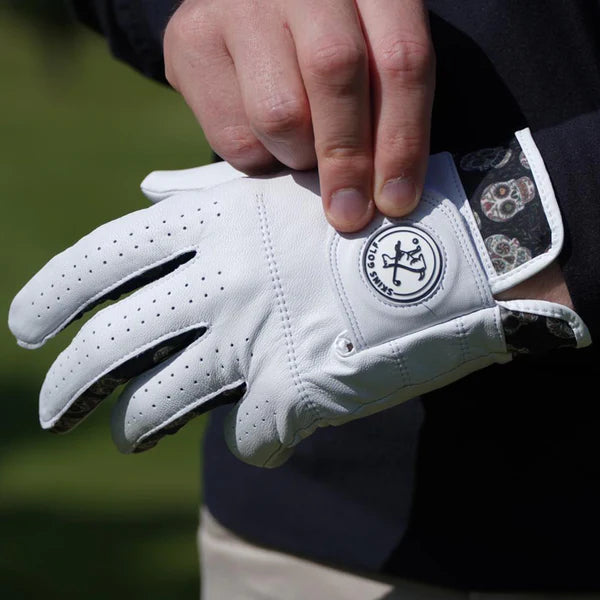
Cabretta is thin, soft sheepskin from hair sheep rather than wool sheep, which is why it stays supple instead of going woolly-thick. AAA grade is the benchmark the tour brands use in their flagship gloves, and it's what every glove we make starts with. The thinness is the whole point: less material between your hand and the club means the grip pressure information arrives uninterrupted.
Where leather wins
Feel. Cabretta transmits the club to your hand. You grip lighter because you can feel more, and lighter grip pressure is free technique.
Grip. The natural surface holds tacky in dry conditions, without the plasticky slide synthetic palms develop as they wear.
Fit. Leather moulds to your hand over the first few rounds until the glove is effectively bespoke. Synthetic keeps the shape it left the factory in, which was nobody's hand. Sizing still decides everything: get the fit right and the moulding works for you.
Breathability. Leather is porous and airs as you play. In July, that's the difference between a glove and a sauna mitt.
Where synthetic wins
Lifespan. Man-made fibres shrug off wear that retires thin leather. A cabretta glove gives you 10 to 12 great rounds; a synthetic gives you more rounds at a level it never rises above. The numbers are in how long a golf glove lasts.
Rain. Wet cabretta turns slippery and dries hard if you mistreat it. Purpose-made wet-weather synthetics grip better soaked than dry. We don't make one, and if most of your golf is played in weather, buy one from a brand that does.
Price and the range. At £12 to £15, a synthetic glove is the right tool for mats and buckets. Range balls off mats are exactly the mileage that kills leather for nothing.


The two-glove answer
Run both. Cabretta on the course, where feel pays; synthetic on the range and in the wet, where it doesn't. Your leather gloves last longer for the division of labour, especially in a rotation (any 3 gloves for £54 exists for this), and cleaning them properly costs ten minutes a month: the method is in how to clean golf gloves.
One construction detail worth paying for either way: stretch panels between the fingers. All-leather gloves go stiff at the knuckles, all-synthetic gloves never feel the club, so ours put AAA cabretta everywhere you grip and lycra everywhere you flex.
Leather vs synthetic FAQs
Are leather golf gloves worth the extra money?
If you play more than a handful of rounds a season, yes. The feel difference shows up on every shot, and at £20.99 for AAA cabretta the premium over synthetic is about the price of a coffee per round of its life.
Do synthetic golf gloves last longer than leather?
Yes, usually by a distance. That's the trade in one line: synthetic lasts longer, leather is better while it lasts. Anyone selling you soft leather that "lasts 30 rounds" is describing a glove you'll stop enjoying at 15.
Are leather golf gloves good in the rain?
No, and we'd rather tell you that here than after checkout. Wet rounds want a wet-weather synthetic pair; your cabretta stays in the bag pocket, dry and grateful.
Is cabretta leather the same as regular leather?
No. Regular leathers are thicker cowhide or pigskin, built for wallets and work gloves. Cabretta is thin sheepskin graded for softness, and AAA is the top of that grading, which is why it's the only leather we use.
Feel on the days it counts, synthetic for the days it doesn't. The feel half of the argument lives in the cabretta leather golf gloves collection, in designs the two-party system never saw coming.